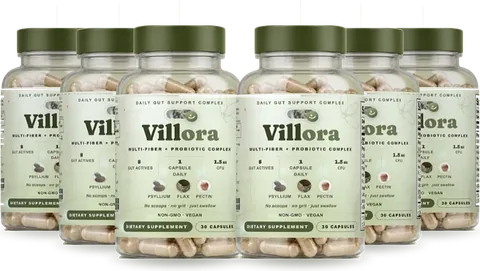
Start with the serving size, then find Dietary Fiber in grams and its percent Daily Value. Five percent or less is low and twenty percent or more is high. Scan the ingredient list for whole foods near the top. Villora's label follows the same logic, and its brand directions are one capsule a day with breakfast and water.
Begin with the serving size · Find the fiber line · Decode the ingredient list · Beware of front-of-package claims · Reading a supplement label · Put it to work this week
- Always read serving size before anything else.
- Percent Daily Value of 5 is low; 20 is high.
- Whole-food ingredients should appear near the top of the list.
- Compare similar products per serving, not per package.
Begin with the serving size
Every number on the panel depends on the serving size at the top. A cereal may list 30 grams as one serving while your bowl holds double that, which doubles every number below it. Before you look at fiber, glance at how many servings the package contains and how many you actually eat.
This one habit prevents most label confusion, and it takes two seconds. Many people are surprised to learn that a small-looking bag of snacks holds three or four servings. Do the multiplication once and the real numbers appear. It is the single most useful label skill, and it applies to every food in the store, from cereal to crackers to frozen meals.
Find the fiber line
Under Total Carbohydrate you will see Dietary Fiber, listed in grams with a percent Daily Value beside it. The percent figure compares one serving to a general daily goal, which makes quick comparisons easy.
Use a simple rule of thumb to scan fast:
- 5 percent Daily Value or less: a low source.
- 10 to 19 percent: a moderate source.
- 20 percent or more: a high source.
- Look for Soluble Fiber and Insoluble Fiber lines when a brand lists them.
- Total Sugars and Added Sugars sit nearby, so check them in the same glance.
Ready to start your routine?
Villora: a vegan multi-fiber + probiotic capsule, one a day, with a 60-day money-back guarantee.
Order Villora NowDecode the ingredient list
Ingredients appear in order by weight, so the first three tell you the most. Look for whole grains, legumes, nuts, seeds, fruits, or vegetables near the top. Words like whole wheat, oats, or beans signal real food; a list that opens with refined flour and sugar tells a different story.
Some products add isolated fibers to boost the number. That can be perfectly fine, but it is useful to know where the grams come from. Our grocery list guide shows how to build a cart around whole-food sources.
Beware of front-of-package claims
Banners such as high fiber, made with whole grains, or good source appear on the front for marketing reasons. Read them as an invitation to flip the box, not as the final word. The panel on the back holds the real numbers.
A helpful habit is to compare two similar items side by side on the shelf: two breads, two crackers, two cereals. Choose the one with more fiber and less added sugar per serving. In a few weeks you will do it automatically. Keep a mental shortlist of favorites that pass your own test, and shopping gets faster each trip. Over a month, that quiet habit shapes the whole pantry without a single restriction or rule.
Reading a supplement label
Supplements use a Supplement Facts panel instead, listing serving size, amounts, and other ingredients. The FDA's dietary supplement page explains how those labels work in general terms, and the NIH Office of Dietary Supplements offers fact sheets on many topics.
Villora is a capsule the brand describes as a multi-fiber and probiotic complex. Its stated directions are one capsule a day, preferably with breakfast, with water. For a closer look at how the label presents its eight listed ingredients, visit the Villora formula page.
Put it to work this week
Pick three items from your cart, read their labels, and write down the serving size and fiber grams for each. You will quickly see which foods deliver and which only look the part.
Pair that awareness with a steady daily routine, and the label becomes a tool instead of a puzzle. For the bigger picture of how a capsule fits alongside food, see the how Villora works overview.