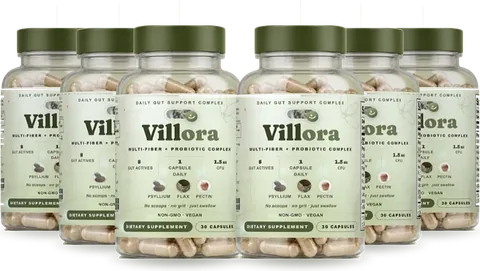
The plants on the Villora™ label have wide-ranging origins. Psyllium comes from Plantago ovata, grown in South Asia. Konjac is a tuber from East and Southeast Asia, oats and flax are field crops of temperate climates, apples and plums are orchard fruits, and black walnut is a tree native to eastern North America. This guide tours them by botany and food culture.
A label with a world map behind it · Seeds and grains: psyllium, oats, and flax · Roots and tubers: the konjac story · Orchards: apples and plums · The forest tree: black walnut · Why origin stories are worth a minute
- The label spans several continents' worth of plants, from tubers to orchard fruit to forest trees.
- Psyllium and konjac come from Asian growing traditions; black walnut is native to North America.
- Oats, flax, apples, and plums are widely familiar food crops.
- This is a botany and culture tour; amounts per ingredient are not given on this site.
A label with a world map behind it
Read the ingredients on a product label and you are looking at a small map of agriculture. The brand lists psyllium husk, oat bran, flax seed, apple pectin, konjac root, plum powder, and green black walnut hull (Juglans nigra) alongside a probiotic culture. Each plant has its own growing region, harvest, and kitchen history.
This guide sticks to botany and culture. It does not describe effects, and amounts per ingredient are not given on this site. For the label itself, see the Villora formula page.
Seeds and grains: psyllium, oats, and flax
Psyllium husk comes from Plantago ovata, a low-growing annual plant with narrow leaves. It has long been cultivated in parts of South Asia, and the husk is the thin coat that surrounds each tiny seed. Harvesters thresh the seeds and then separate the husk from them.
Oat bran is the outer layer of the oat, a cool-climate cereal grown across North America, Europe, and beyond. Flax is among the oldest cultivated plants, grown for both its seeds and its stem fibers, which become linen. Its small seeds ripen in round pods on slender stalks topped with blue flowers.
Ready to start your routine?
Villora: a vegan multi-fiber + probiotic capsule, one a day, with a 60-day money-back guarantee.
Order Villora NowRoots and tubers: the konjac story
Konjac root is the corm, or underground storage stem, of a plant native to parts of East and Southeast Asia. It takes several growing seasons to mature, and the harvested corm is washed, sliced, and dried or milled. In Japanese cuisine konjac appears as firm, jelly-like cakes and noodles that carry the flavor of broths.
It is a good reminder that many fibers on supplement labels are also real foods with long culinary histories, not laboratory inventions.
Orchards: apples and plums
Apple pectin is a fiber found in the cell walls of apples, which makes the apple one of the best-known fruit crops in temperate regions around the world. Pectin is also the ingredient home cooks know from jam making, where fruit, sugar, and heat produce a spoonable set.
Plum powder starts with plums, stone fruits grown in orchards across Europe, Asia, and North America. Drying and grinding the fruit creates a shelf-stable powder, the same principle that gives us dried prunes. Both ingredients bring familiar orchard produce into a capsule-friendly form.
- Apples: temperate orchards on nearly every continent
- Plums: stone fruit orchards across Europe, Asia, and North America
The forest tree: black walnut
Juglans nigra, the black walnut, is a large hardwood tree native to eastern North America. It is prized for its dark timber and its distinctive nuts. The label lists the green hull, the thick husk that wraps the nut while it develops on the tree, which turns dark as it matures.
Foragers and gardeners know the hull for the deep brown stain it leaves on hands, a useful clue to how strongly pigmented it is.
Why origin stories are worth a minute
Knowing where an ingredient comes from turns a label into something concrete. It also helps you spot which items you already know from your kitchen. The What Is Villora page gives the product overview, and the USDA's FoodData Central lets you browse nutrition data for many of the foods mentioned here.
The brand states that Villora is made in the USA in a GMP-certified facility and is vegan, non-GMO, and gelatin-free. If the tour made you curious about the capsule, the pricing page lists pack sizes and the 60-day money-back guarantee.